
Two 13-year-old boys, a close friendship, and an irrevocable loss—this almost sums up the entirety of Belgian director Lukas Dhont's second feature film, "Close."
Simple, beautiful, solemn, and enduring. This 31-year-old openly gay director follows his delicately sensitive queer perspective that won him the Cannes Golden Camera for his debut "Girl." With a light and agile touch, he depicts the purest and most pristine attachment between people, yet he mercilessly reveals how fragile and vulnerable such a relationship is in a sensitive social environment.
Cannes seems intent on nurturing and supporting Dhont as a "direct successor," hoping to replicate the myth of Xavier Dolan. They are both young and talented, both openly and flamboyantly asserting their minority sexual identities. However, Dhont seems to have attracted more controversy than Dolan. "Girl" won three awards at Cannes, focusing on the process of SRT treatment. Among films that focus on transgender culture, "Girl" is undoubtedly ahead of its time. Yet, the climax of the film is so backward and dangerous, exposing the author's simplistic and shallow understanding of "what it means to be a woman." More fatally, Dhont cast a bisexual boy, Victor Polster, to play a transgender character, a choice that was met with opposition and boycott from the American transgender community. These various controversies turned "Girl" into a tragic yet problematic work.

"Close" is similar. Despite being Dhont's first film to enter the Cannes main competition, it successfully won the Jury Prize (there were even rumors at one point that it was a strong contender for the Palme d'Or). However, the oversimplification issues present in "Girl" also appear in "Close," making it only half a masterpiece.
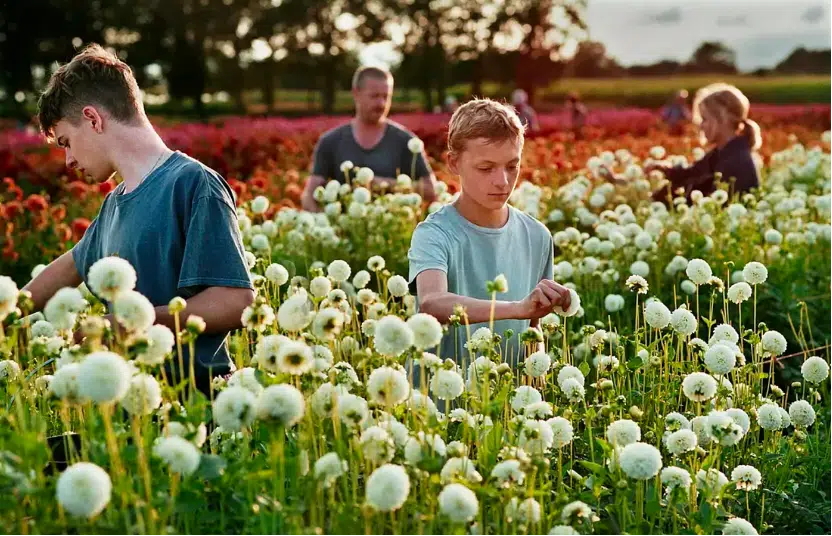
There is a clear dividing line within the film, distinctly separating its focus and tone. In the first 45 minutes, we see the fairy-tale pure friendship between the two protagonists, Leo and Remi. A kind of intimacy very common among teenage girls but rare among boys. During the day, they build imaginary kingdoms, share secret fortresses, and play and wander through the dahlia fields managed by Leo's family. At night, they sleep in each other's arms, a simple reliance as if their dreams were holding hands.
As the idyllic summer passes, the children are pushed into a more colorful yet perilous environment. With the new school term, their innocent relationship is immediately questioned by society. In early adolescence, boys and girls are searching for a clear and independent self-identity. At this moment, curious new female classmates inquire about Leo and Remi's relationship: "Are you together?" Such questions may be innocent, but the labels implied by "together" and their consequences are undoubtedly overwhelming for 13-year-olds.
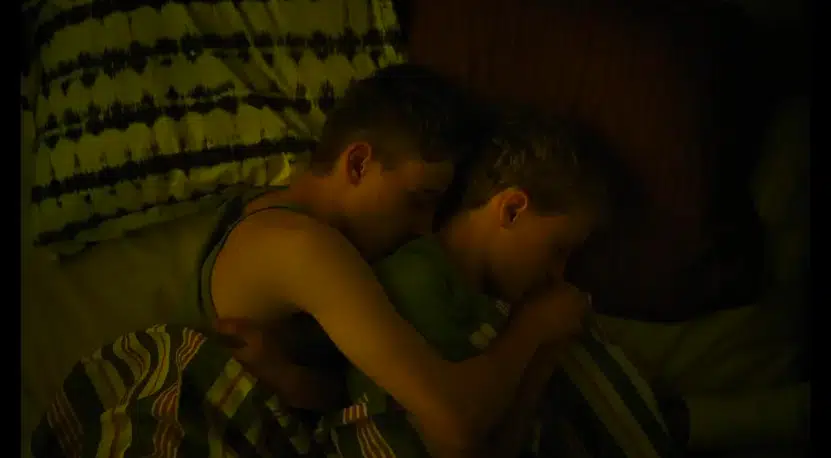
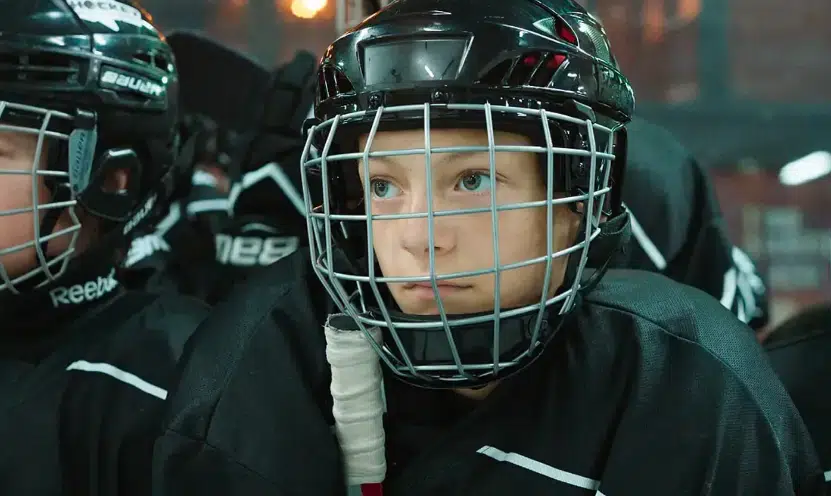
Even in a developed and progressive country like Belgium, the heteronormative culture can easily disrupt and sever the immaculate emotional bonds between boys. A world filled with love often collapses under the weight of societal expectations. Leo denies and doubts his own identity and his relationship, choosing to conform to societal norms by displaying masculinity: despite not being good at ice hockey, he joins the team, with the helmet's gridiron becoming a masculine cage. He deliberately distances himself from Remi, using the rupture to understand what it means to be a man in modern society. These friends drift apart in and out of school, but we can see they still care about each other. Yet, they struggle in the whirlpool of identity exploration and emotional confusion. One day, after a school-organized extracurricular activity, Leo can no longer find any trace of Remi. The seemingly more straightforward one of the two suddenly chooses to end his own life, leaving behind shocked and grieving family and friends who spend the rest of their time searching for answers.
The second half of "Close" turns to explore the issue of adolescent suicide. Although "loss" is still written under the theme of "closeness," this layer of "closeness" differs from that in the first half. For Leo, the days of cuddling with Remi have become wounds that require a lifetime of healing and release. Pain is the proof of once loving. This is why the film chooses to use "Close" as the title rather than "Intimacy." It reflects a de-sexualized (or pre-sexual) state, but more importantly, it embodies the profound meaning of "loss."
Variety magazine's film critic Peter Debrug commented, "Although 'Close' is sincere, this tragedy feels more like a narrative tool aimed at proving a certain ideological viewpoint." The "certain" viewpoint he hesitates to elaborate on contains many possibilities. It relates to the denunciation of machismo and heteronormative culture, as well as concern for adolescent psychology and school bullying.
Furthermore, "Close" could simply be a cruel coming-of-age story. It tells us that glass is fragile, and colorful clouds are fleeting. Behind its beautiful naturalist facade lies the dirt of adult society's frightening words and the impossibility of remaining unscathed. But no matter which interpretation mode is applied, Remi's departure is a violently fallen domino. It directly plunges the audience into a massive emotional storm, and the significant tragic effect easily overshadows more possibilities belonging to this story, leaving many unresolved issues like lingering shadows.
The foremost among them is whether "Close" should be classified and discussed within the framework of queer or LGBTQ cinema. Mainstream overseas film media generally believe that the core of this film is about boyhood friendship, narrating a buddy story, even directly stating they are "not at all lovers." This is because Dhont deliberately and stubbornly avoids this issue in the film, despite creating an extremely ambiguous atmosphere. Similar to Alexander Zolotukhin's "Brothers in Every Inch" (2022), "Close" ultimately wants to explore a relationship that has nothing to do with how the outside world defines them. Closeness is closeness; beyond friendship, love, and familial ties, people can have a more transcendent and pure relationship.
Undeniably, the second half of "Close" is an overwhelming emotional tsunami, capable of drowning the Lumière and Debussy theaters in tears, leaving many journalists sobbing. We are moved by Eden Dambrine’s eyes, as clear as seawater, which seem to project an entire universe of sorrow when he looks at the camera. But behind the heartbreak, Dhont seems not to intend to provide more explanations.
Knowing this makes the tragic color of "Close" even more prominent. But in a certain dimension, this layer of tragedy is so redundant. Dhont destroyed a fairy tale in exchange for tons of tears. Anyone who has adjusted their behavior due to others' homophobia can identify with Leo and Remi and find a footnote in their own heart-wrenching past. But death is always so efficient, simple in action, immense in momentum, and lingering in aftertaste. Enveloped in such a pure relationship, we find no precise outlet for our sadness and anger over Remi's death: after all, they are two 13-year-old children, if they do not want to be defined yet, how can we bear to blame a phase of exploration in their growth?
Ultimately, "Close" diffuses its symptomatic meaning in this way. What remains on the screen is the annual cycle of the dahlia fields: cultivation, blooming, harvesting, withering—a time-worn symbol of the blossoming and fading of teenage hearts. It is extremely beautiful. But when you wander through this shoulder-high flower field, the beauty is so dazzling that we forget the clear direction.





Share your thoughts!
Be the first to start the conversation.